7 min read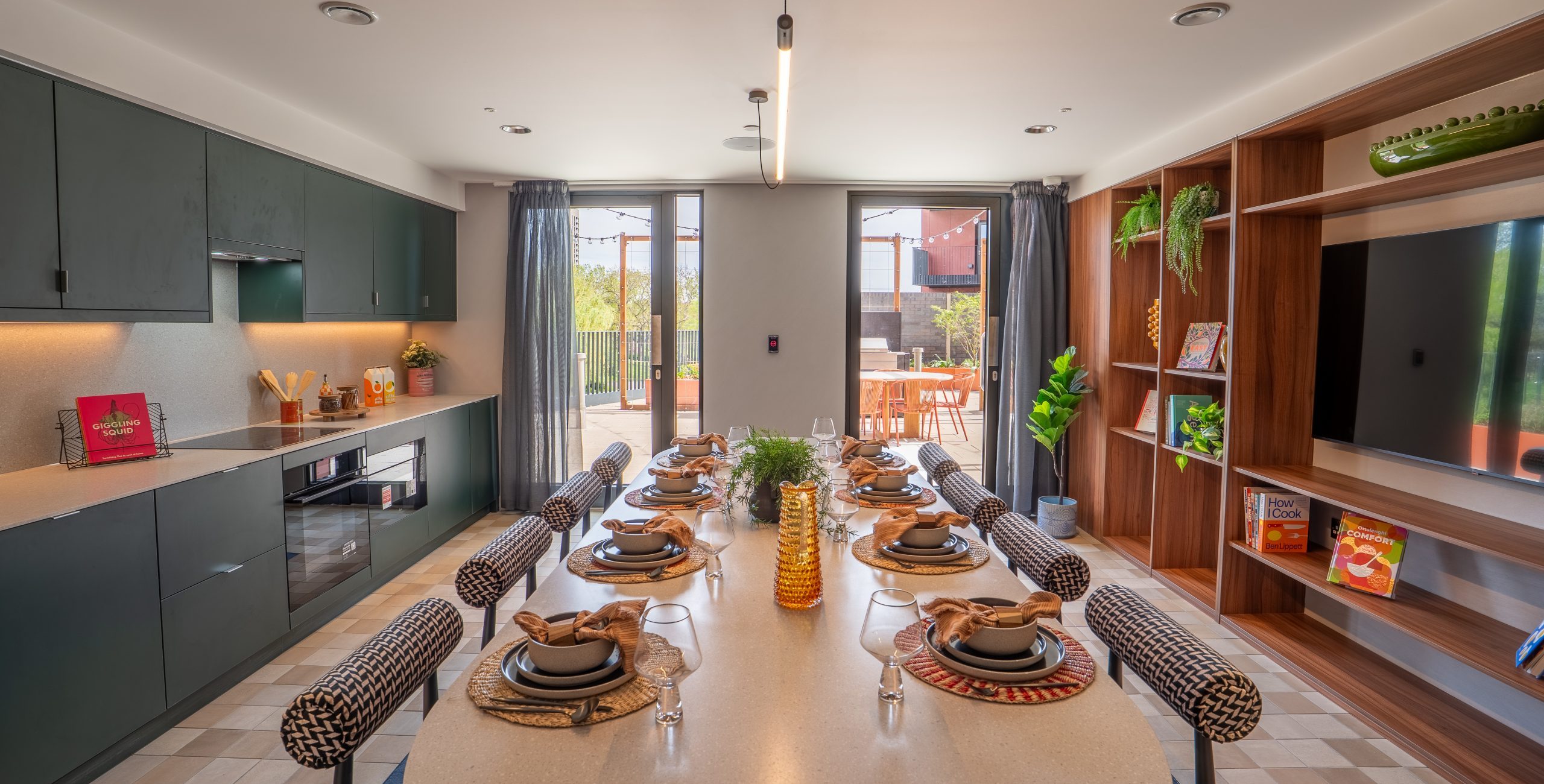
The role of student accommodation in the UK is undergoing a profound transformation. Once viewed as a functional necessity or simply a place for students to sleep, today’s Purpose-Built Student Accommodation (PBSA) has evolved into a critical component of the wider higher education experience, as well as a significant asset class within the real estate sector.
Driven by shifting student expectations, chronic housing shortages, and new economic and environmental pressures, student accommodation is now at a turning point. For architects and designers, this presents both a challenge and an opportunity: to rethink what student living should be in a rapidly changing world.
A sector under pressure: demand outstripping supply
At its core, the UK student accommodation market is defined by a long-standing structural imbalance between demand and supply. Student numbers continue to rise and are supported by strong international recruitment and increasing domestic participation, yet the delivery of new accommodation has consistently been behind. [CBRE].
Estimates suggest that the UK faces a shortfall of hundreds of thousands of student beds, with some projections placing unmet demand at around 600,000 spaces. The rate of new delivery (typically 15,000–18,000 beds annually) remains well below what is required to close this gap.
This imbalance has driven consistently high occupancy levels, often exceeding 95% and sustained rental growth despite wider economic uncertainty.
For designers, this context demands innovative responses: creating high-quality, high-density schemes that maximise site potential while maintaining liveability and long-term value.
The changing student: more diverse, more demanding
The notion of the “typical student” is rapidly becoming outdated. Today’s student population is more diverse than ever, encompassing mature learners, part-time students, commuters, those balancing study with work, and international students [University Design Forum].
At the same time, expectations have shifted significantly. Students no longer compare their accommodation to outdated halls of residence; they compare it to build-to-rent developments, co-living schemes, and even hospitality environments.
Key decision drivers now extend beyond price and location to include:
- Quality of living environment
- Access to social and communal spaces
- A sense of identity and belonging
Indeed, softer factors such as “feeling right” and access to a vibrant social life are increasingly important in student choices.
In recent years, student accommodation has evolved beyond providing a place to live, with purpose-built student accommodation (PBSA) increasingly incorporating amenities such as gyms, cinema rooms, co-working spaces and shared lounges to support students’ lifestyles.
This evolution demands a more complex, user-centred approach to design.
The rise of amenity-led living
In recent years, student accommodation has evolved beyond providing a place to live, with PBSA increasingly incorporating amenities such as gyms, cinema rooms, co-working spaces and shared lounges to support students’ lifestyles.
This shift brings student housing closer in line with sectors like hospitality and build-to-rent, where experience, service, and community play a central role in creating value. Designers are increasingly tasked with creating environments that feel like a “home away from home”, rather than institutional housing.
Crucially, these spaces are not simply add-ons; they play a central role in shaping the social fabric of student living.
Designing for wellbeing and community
The importance of accommodation in supporting student wellbeing is now widely recognised. Research highlights the role of living environments in fostering a sense of belonging, security, and emotional attachment during what is often a significant life transition [Galliford Try].
As a result, there is increasing emphasis on:
- Designing for social interaction
- Creating inclusive, accessible spaces
- Supporting mental and physical health
Architectural responses include a greater focus on natural light, communal areas, and layouts that encourage chance encounters and community formation.
Rather than simply housing students, contemporary PBSA is expected to actively support their development, wellbeing, and academic success.
Repurposing Student Accommodation
Research by real estate advisors Students First Group (SFG) reveals that UK universities collectively require at least £13.8 billion to rebuild or refurbish their ageing residential estates. The study indicates that over 60% of university-owned accommodation, equivalent to around 200,000 beds, falls short of modern quality and sustainability standards. This information shows the growth of the student accommodation market.
Student accommodation presents complex challenges for architects, as they must balance strict financial constraints with the need to foster community and support mental wellbeing, ensuring buildings are fit for the future.
Flexibility in the age of hybrid learning
The COVID-19 pandemic accelerated changes in how students learn, exposing the limitations of traditional accommodation models. Many existing schemes were not designed to support extended in-room study or hybrid learning environments [University Design Forum].
As a result, there is a growing demand for:
- Dedicated study areas separate from sleeping spaces
- Flexible, multi-use communal zones
- Acoustic and spatial strategies that support concentration
This has significant implications for room typologies and overall building design. The traditional cluster flat is being reconsidered, with greater emphasis on adaptability and long-term usability.
Affordability and the need for balance
While expectations are rising, affordability remains a critical issue. A significant proportion of students report struggling with the cost of accommodation, with many questioning the value for money of current provision [SaveTheStudent].
This presents a fundamental tension within the sector: how to deliver high-quality, experience-led environments while maintaining accessibility.
The result is a growing focus on the “mid-market” and schemes that balance cost, quality, and amenity provision. For architects, this requires careful consideration of:
- Efficient layouts
- Material choices
- Operational costs over the building lifecycle
Design will play a key role in ensuring that affordability does not come at the expense of quality. It’s about ensuring that the designs that architects complete are suitable for developers and align with budgets.
Sustainability and future-proofing
Sustainability is now a central consideration in both design and investment decisions. Students themselves increasingly prioritise environmentally responsible living, while ESG requirements are shaping funding and development [PBSAX].
This is driving innovation in:
- Energy-efficient building systems
- Low-carbon materials
- Long-life, adaptable design strategies
Student accommodation presents a significant opportunity to lead in sustainable residential design.
The architect’s role: shaping the next generation of student living
As the student accommodation sector continues to evolve, the role of the architect is becoming more critical and more complex.
It is no longer enough to deliver efficient layouts and meet planning requirements. Designers must now reconcile a wide range of competing demands:
- Density vs. liveability
- Cost vs. quality
- Standardisation vs. identity
- Short-term viability vs. long-term adaptability
At the same time, student accommodation is playing an increasingly important role in shaping towns and cities, contributing to regeneration and placemaking in key university locations.
It’s more than accommodation
Student accommodation is no longer simply a supporting component of higher education; it is a central part of the student experience, an important driver of urban development, and a rapidly evolving design. By embracing innovation, prioritising user experience, and responding to the changing needs of students, architects can help redefine what student living looks like and ensure it remains fit for the future.
At DMWR Architects, having successfully delivered over 26,000 student rooms, we take pride in delivering a diverse range of student accommodation projects. From initial design through to completion, we understand what students need and want and work closely with our clients to create accommodation that meets their vision.
Sources
CBRE https://www.cbre.co.uk/insights/books/uk-real-estate-market-outlook-2024/student-accommodation
https://www.gallifordtry.co.uk/media/1154/accommodation-and-student-wellbeing-report-digital.pdf
https://www.pbsax.com/guides/uk-student-housing-market-report